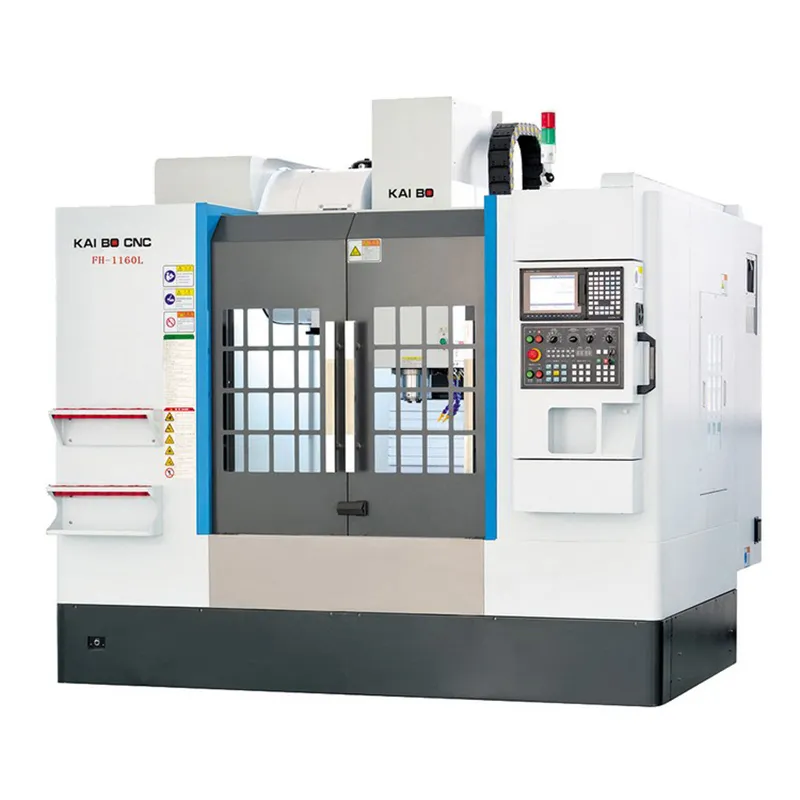
Overcoming Challenges in New Energy Battery Manufacturing: Why Five-Axis Vertical Machining Centers Are the Optimal Solution

10 12,2025
KAIBO CNC
Industry Research
The production of high-precision graphite electrodes and complex components in the new energy battery sector faces significant challenges with traditional three-axis machining centers, including low efficiency, multiple setups, and inconsistent surface quality. This article examines how five-axis vertical machining centers, exemplified by the Kaibo CNC FH855L with RTCP technology, address these issues effectively. Key advantages include enhanced positioning repeatability, superior thermal stability, and improved adaptability for thin-walled structures. Supported by real-world customer data demonstrating a 9% increase in yield and a 40% reduction in tool change time, the analysis highlights substantial improvements in both productivity and product quality. Additionally, comparisons across applications such as graphite electrodes, aerospace blades, and mold cavities underline the broad relevance of five-axis technology. The findings provide decision-makers with a solid foundation for actionable technological upgrades.

Overcoming Manufacturing Challenges in the New Energy Battery Sector: Why the Five-Axis Vertical Machining Center Reigns Supreme

The rapid expansion of the new energy battery industry hinges on the ability to precisely manufacture complex components like graphite electrodes. However, traditional three-axis machining centers often fall short in meeting the stringent requirements for efficiency and surface quality. Frequent re-clamping and suboptimal thermal stability lead to bottlenecks in production and inconsistent part quality, posing a significant hurdle for manufacturers striving to maintain competitive advantage.

Precision and Productivity: Three-Axis vs. Five-Axis Machining

Three-axis machining centers operate primarily along the X, Y, and Z axes, requiring multiple setups and repositioning for complex geometries — a time-consuming process that undermines throughput and precision. By contrast, five-axis vertical machining centers add simultaneous rotational movement (A and C axes), enabling more intricate contouring, reducing setup times, and improving surface integrity.

This crucial difference directly impacts the manufacturing of graphite parts with thin walls and complex shapes, where minimal distortion and exacting surface finish are mandatory. By cutting down on the number of re-clamps, five-axis machines reduce cumulative alignment errors that plague three-axis systems.

Customer Insight: “Since switching to the FH855L five-axis vertical machining center, we observed a 9% increase in first-pass yield and a 40% reduction in tool change duration, drastically boosting our delivery capabilities.” — Senior Production Manager, Leading Battery Manufacturer

Unique Advantages of the FH855L: RTCP Control, Thermal Stability, and Thin-Wall Adaptability

The FH855L model from Kaibo CNC is engineered to tackle the nuanced demands of new energy battery component machining. Its RTCP (Rotating Tool Center Point) functionality dynamically adjusts tool orientation, preserving the tool tip’s precise position during multi-axis rotations — a critical factor for maintaining dimensional accuracy on complex surfaces.

Additionally, the FH855L incorporates thermal displacement compensation and optimized cooling systems that mitigate heat-induced dimensional drift during extended runs, ensuring consistent tolerances even under high volume production. Its rigid structure combined with vibration dampening enhances milling performance on delicate thin-walled graphite pieces, reducing chatter marks and improving surface finish beyond the capabilities of standard three-axis machines.

Comparative Application Scenarios: From Graphite Electrodes to Aerospace Blades and Mold Cavities

While the five-axis vertical machining center excels in new energy battery graphite parts, its versatility extends to other sectors requiring precision machining of intricate geometries. For instance:

  • Graphite Electrodes: Enhanced first-pass accuracy reduces waste in high-value carbon components.
  • Aerospace Blades: Complex curves and thin-walled profiles benefit from multi-axis maneuverability and thermal control.
  • Mold Cavities: Complex internal geometries achieve superior surface finish with fewer setups.

This cross-industry adaptability underscores the FH855L's capacity to deliver long-term ROI by consolidating multiple machining steps and improving overall equipment effectiveness (OEE).

Quantifiable Performance Gains Drive Strategic Upgrades

Buyers seeking to future-proof their manufacturing lines will find compelling evidence in the measurable benefits brought by five-axis vertical machining technology:

Performance Metric Three-Axis Center FH855L Five-Axis Improvement
First-Pass Yield (%) 85% 94% +9%
Tool Change Time (seconds) 60 36 −40%
Setup Reduction (times) 3+ 1 −66%

These figures translate into substantial cost savings, reduced lead times, and higher customer satisfaction — critical metrics for decision-makers evaluating capital equipment investments.
Name *
Email *
Message*

Recommended Products

<#if (articleDetails.articleDetailsRelatedArticles.articleList?has_content)?? && (articleDetails.articleDetailsRelatedArticles.articleList?size>0)> <#if (articleDetails.articleDetailsRelatedArticles.isShow)?? && articleDetails.articleDetailsRelatedArticles.isShow> <#if (articleDetails.articleDetailsRelatedArticles.title)?? && articleDetails.articleDetailsRelatedArticles.title!="">

${articleDetails.articleDetailsRelatedArticles.title}

<#list articleDetails.articleDetailsRelatedArticles.articleList as list>
<#if (list.imgUrl?has_content)?? && (list.imgUrl?has_content)> ${list.imgAlt} <#else> img

${list.title}

${(list.updateTime)?number_to_datetime?string('dd MM ,yyyy')}
Contact us
Contact us
https://shmuker.oss-cn-hangzhou.aliyuncs.com/tmp/temporary/60ec5bd7f8d5a86c84ef79f2/60ec5bdcf8d5a86c84ef7a9a/thumb-prev.png