
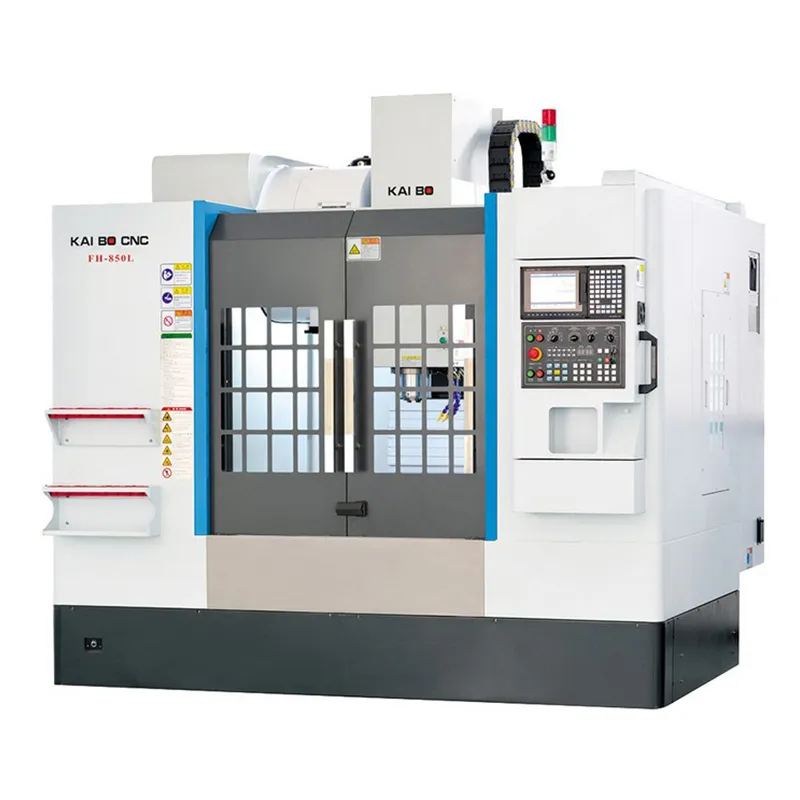
In today’s high-tech manufacturing landscape, precision and operational efficiency remain key drivers for competitive advantage, especially in industries like aerospace, precision molds, and new energy batteries. The demand for complex, high-accuracy components presents significant challenges to traditional machining platforms. Enter the FH855L RTCP Five-Axis Vertical Machining Center from Ningbo Kaibo CNC Machinery Co., Ltd.—a breakthrough solution reshaping graphite material machining and drastically improving production outcomes.
Traditional three-axis machining centers have long served manufacturers but fall short when processing highly intricate, thin-walled graphite parts. Key limitations include multiple setups leading to longer production times and increased risk of dimensional errors, impacting yield rates.
The FH855L RTCP five-axis vertical machining center addresses these pain points through simultaneous multi-axis control, reducing the need for frequent part re-clamping, streamlining the machining process, and optimizing tool paths.
Designed with industry-leading RTCP (Rotating Tool Center Point) tool control technology, the FH855L provides:
A leading aerospace parts manufacturer reported a remarkable uplift in first-pass yield, increasing from 82% to 93% after replacing legacy three-axis centers with the FH855L. Tool change frequency decreased by 40%, driving a 12% overall reduction in cycle time per part.
Similarly, a new energy battery supplier’s transition to FH855L enabled the processing of complex electrode graphite parts with 25% higher dimensional precision, directly translating to improved battery performance and longevity.
| Metric | Three-Axis Center | FH855L Five-Axis RTCP Center | Improvement |
|---|---|---|---|
| First-Pass Yield | 82% | 93% | +13.4% |
| Average Tool Change Time | 60 seconds | 35 seconds | -41.7% |
| Cycle Time per Part | 100 minutes | 88 minutes | -12% |
RTCP enables the spindle to maintain the tool center point precisely during tilt and rotation, eliminating geometric errors common in multi-axis machining. This synchronization translates into smoother tool paths, less surface scalloping, and higher part integrity. Especially when working with challenging graphite materials prone to chipping, this precise control prevents defects and material waste.
Moreover, the FH855L’s robust design incorporates optimized cooling and spindle technology, facilitating machining stability even in prolonged production runs, ensuring steady processing quality without degradation.
While this case study centers on graphite machining, the FH855L RTCP five-axis center demonstrates measurable benefits across:
The leap from three-axis to advanced five-axis machining, empowered by RTCP technology, marks a pivotal transition for manufacturers aiming to meet escalating quality standards and throughput demands. Through real-world application and empirical data, the FH855L stands out as a dependable, precision-driven centerpiece for modern graphite and complex component processing.



 <#else>





