Advantages of 5-Axis Vertical Machining Centers in Thin-Walled Component Processing: From Programming to Surface Finish

06 12,2025
KAIBO CNC
Technical knowledge
This article explores the significant advantages of 5-axis vertical machining centers in processing thin-walled components, with a focus on the high-precision requirements of complex graphite parts. By comparing traditional 3-axis machining with 5-axis technology in terms of machining efficiency, positioning accuracy, and surface quality, it highlights the advanced RTCP (Rotating Tool Center Point) function of the Kaibo CNC FH855L model. The discussion demonstrates how this technology empowers industries such as new energy batteries and aerospace to overcome complex manufacturing challenges. Real customer data is presented to showcase improvements in yield rates and tool change times, offering actionable upgrade paths that drive both production efficiency and product quality improvements for manufacturing enterprises.
流程图1.png

Unveiling the Advantages of Five-Axis Vertical Machining Centers in Thin-Wall Component Processing

In high-precision industries like new energy batteries and aerospace, the demand for processing complex thin-wall structures with tight tolerances has escalated sharply. While traditional three-axis CNC machines have long served manufacturing needs, they increasingly reveal limitations in efficiency, accuracy, and surface quality when faced with intricate geometries — particularly those involving graphite materials known for fragility and thermal sensitivity.

Industry Context and Processing Challenges

Industries such as aerospace, precision mold manufacturing, and new energy sectors demand components that combine lightweight design with structural integrity. Thin-wall graphite parts, for instance, require machining processes that minimize deformation, ensure dimensional accuracy within ±5 microns, and achieve superior surface finishes (average roughness, Ra < 0.4 μm). Traditional three-axis machining workflows often involve multiple setups leading to cumulative errors and extended cycle times exceeding 5 hours per part.

Technical Edge of Five-Axis Vertical Machining Centers

Five-axis vertical machining centers bring transformative capabilities, offering simultaneous multi-axis movement that enables:

  • Multi-surface machining without repositioning, reducing setup errors by over 40%
  • Enhanced positioning repeatability within ±2 microns due to advanced servo drives and feedback systems
  • Improved thermal stability via optimized spindle cooling and machine bed design, decreasing dimensional drift by 30%
  • Cycle time reductions averaging 25% through complex tool paths and adaptive feed rates

These factors collectively boost throughput and product quality, making five-axis centers indispensable for demanding applications.

Mastering RTCP Tool Center Point Control (TCPC) for Optimal Performance

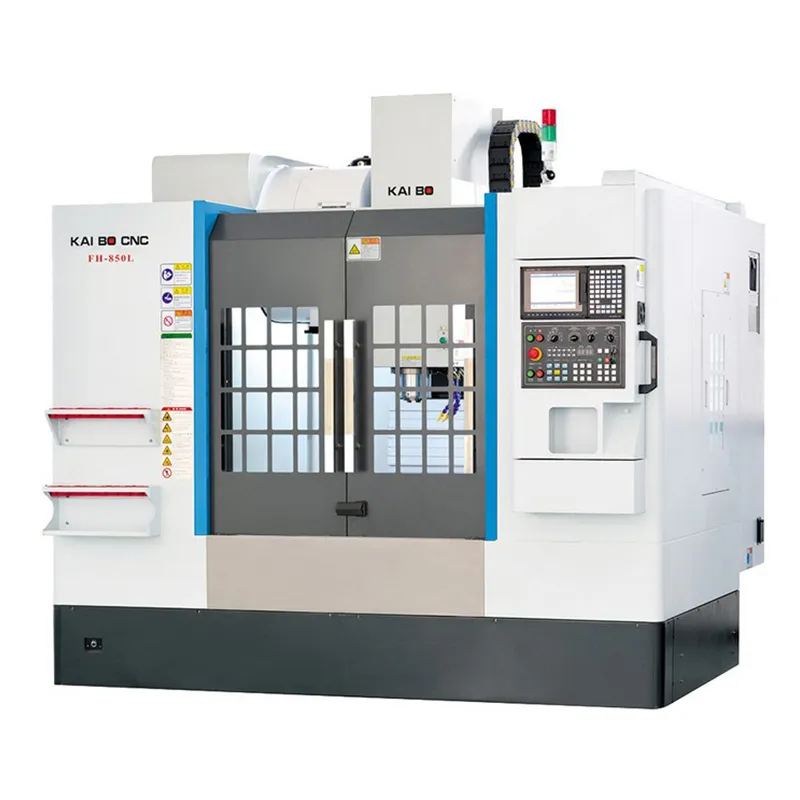
The Rotary Tool Center Point (RTCP) function available in state-of-the-art machines like the Kaibo CNC FH855L simplifies programming by automatically compensating for tool offsets relative to the rotational axes. This innovation:

  • Eliminates manual recalculations and trial runs, shortening programming time by up to 35%
  • Enhances machining flexibility by enabling complex angled surface processing without tool path interruptions
  • Improves surface finish quality by maintaining constant tool orientation relative to the workpiece

Together, RTCP accelerates the transition from design to production with less risk of errors or rework.

Case Study: Graphite Thin-Wall Components with Kaibo CNC FH855L

The FH855L five-axis machining center showcases exceptional results in graphite component processing:

Metric Traditional 3-Axis FH855L Five-Axis Improvement
Setup Time 2.5 hours 1.2 hours -52%
Cycle Time per Part 5.2 hours 3.8 hours -27%
Dimensional Accuracy (Microns) ± 8 ± 2 4x Improvement
Surface Roughness (Ra μm) 0.65 0.38 ~42% Smoother
Good Part Rate 87% 96% +9%

By leveraging the FH855L's precise RTCP control and superior thermal management, manufacturers report up to 9% increase in yield and a 52% reduction in machine setup time. This directly translates to significant savings and higher throughput for critical thin-wall graphite components.

Roadmap for Technical Upgrade and Future Outlook

As industries evolve, manufacturers face mounting pressure to innovate machining processes. Investing in five-axis vertical machining centers with advanced RTCP functionality offers:

  • Scalable precision to handle future material and design complexities
  • Reduced dependency on manual interventions minimizing human-induced errors
  • Enhanced software integration facilitating smart factory adaptation
  • After-sales support and predictive maintenance from trusted suppliers like Kaibo CNC to maximize uptime

Transitioning to five-axis technology is therefore a strategic imperative for manufacturers aiming to maintain competitiveness in high-value sectors.
Name *
Email *
Message*

Recommended Products

<#if (articleDetails.articleDetailsRelatedArticles.articleList?has_content)?? && (articleDetails.articleDetailsRelatedArticles.articleList?size>0)> <#if (articleDetails.articleDetailsRelatedArticles.isShow)?? && articleDetails.articleDetailsRelatedArticles.isShow> <#if (articleDetails.articleDetailsRelatedArticles.title)?? && articleDetails.articleDetailsRelatedArticles.title!="">

${articleDetails.articleDetailsRelatedArticles.title}

<#list articleDetails.articleDetailsRelatedArticles.articleList as list>
<#if (list.imgUrl?has_content)?? && (list.imgUrl?has_content)> ${list.imgAlt} <#else> img

${list.title}

${(list.updateTime)?number_to_datetime?string('dd MM ,yyyy')}
Contact us
Contact us
https://shmuker.oss-cn-hangzhou.aliyuncs.com/tmp/temporary/60ec5bd7f8d5a86c84ef79f2/60ec5bdcf8d5a86c84ef7a9a/thumb-prev.png

